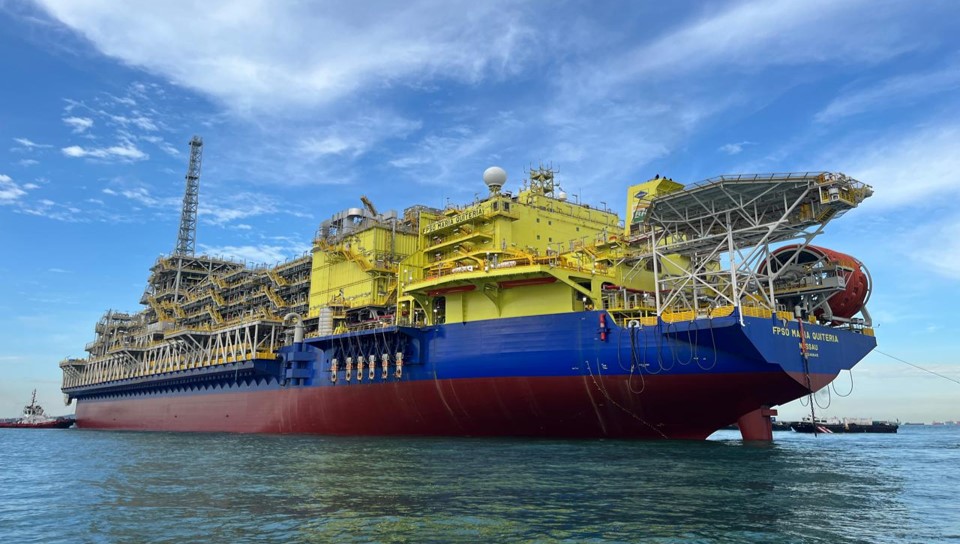
The Maria Quitéria platform vessel has arrived in Brazil, destined for the Jubarte field, in the Parque das Baleias complex, in the Espírito Santo portion of the Campos Basin. It is an FPSO (floating oil production, storage and transfer system) unit, equipped with technologies to reduce emissions, including the combined cycle in power generation – which allows for greater operational efficiency combined with a reduction of approximately 24% in operational greenhouse gas emissions.
In line with the company’s decarbonization strategy, the FPSO Maria Quitéria is scheduled to start operating by the end of this year, thus advancing the schedule set out in Strategic Planning 24-28, which was to start operating in 2025. The unit will have the capacity to produce up to 100,000 barrels per day (bpd) of oil, in addition to processing up to 5 million m3 of gas/day and injecting around 330,000 bpd of water, interconnected to eight production wells and eight injection wells.
With a height of 156 meters up to the flare – the equivalent of the height of the Convento da Penha in Vitória (ES) – and a length of 333 meters, the platform will be installed in a water depth of 1,385 meters – comparable to twice the height of Morro do Moxuara, located in the capital of Espírito Santo. In addition, it will have the capacity to generate 100 MW of energy, enough to supply a city with 230,000 inhabitants.
Boosting a low-carbon future
The FPSO Maria Quitéria demonstrates Petrobras’ innovative DNA in Espírito Santo, where the company installed its first E&P Integrated Operations Center and implemented pilots such as the use of mixed reality to support operations (Ativo 360º) and the first 3D printing laboratory to support operations in the company.
“With an eye on the future, the FPSO Maria Quitéria project marks the entry into operation of a technology that will be a turning point in the company’s decarbonization strategy, the use of natural gas in internal combined cycle electricity generation, with the potential to reduce emissions by up to 24%,” stated the Director of Exploration and Production, Sylvia Anjos.
 Brazil Energy Insight
Leave a comment