This free translation may be of interest
Article by Paloma Amorin and Thiago Silva partners at Vieira Rezende Advogados
(epbr) The development of the offshore wind sector in Brazil requires the consolidation of a robust legal and regulatory framework. Although there has been a framework approved since 2022 (Decree 10,946/2022), several pending regulatory actions remain undefined.
Bills have been under discussion in the Legislative Branch since 2018, with significant progress achieved in November 2023 due to the approval of Bill 11,247/2018 in the Chamber of Deputies – now renumbered as Bill 5,932/2023 in the Senate.
Regardless of how regulation will proceed, it is imperative to establish an effective and fully regulated framework – which we do not have today – whether through the advancement of pending regulation for Decree 10,946/2022 or through the approval of Bill 5,932/2023 and the promulgation of its subsequent regulation.
A brief history of Bill 5,932
Several Bills related to offshore wind energy were under discussion in the Brazilian National Congress. In 2023, all other projects under discussion, including Bill 576/2021 – then considered the most advanced – were consolidated in Bill 11,247/2018. On November 28, 2023, the Chamber of Deputies approved a replacement for Bill 11,247/2018, which was submitted to the Senate, being renumbered to Bill 5,932/2023.
The content related to offshore wind power in Bill 5923/2023 adopts several of the factors recommended by the report Key Factors for Successful Development of Offshore Wind in Emerging Markets, produced by the World Bank, which is quite satisfactory. However, it remains uncertain whether Bill 5,932/2023 will receive approval from the Senate.
This is because the apparent pacification of the issue in Congress seems to have been generated more due to the approved amendments, which meet demands concentrated on issues unrelated to the offshore wind energy framework, than due to the adequacy and robustness of the legal text necessary to enable the harnessing the energy potential of the offshore wind industry. This fact generated criticism and the potential need for the text to be revised by the Senate.
From a tax perspective, although there is still no indication of which tax incentives, if any, will apply to the new segment – with the aim of reducing the cost to be incurred and, thus, enabling the implementation of new projects – unusually, they have been foreseen certain tariff conditions favorable to hydroelectric and thermoelectric generation projects.
This favoritism generated severe criticism of the Bill, as such initiatives have no relationship with the offshore wind farm segment – on the contrary, they guarantee greater competitiveness for other generation sources, which will possibly reduce the competitiveness of clean energy generated from offshore wind farms. – in addition to not maintaining synergy with the energy planning idealized by the Federal Government’s green agenda.
In addition to the disparity outlined above, offshore power generation plants impose additional responsibilities and costs compared to onshore projects, which is another factor that makes the implementation of such projects difficult.
We remind you that, whether onshore or offshore, the entrepreneurs behind energy generation projects are responsible for: (i) connection facilities to the SIN (National Interconnected System), including expansions and reinforcements to the basic network; (ii) procedure for integration into the SIN of projects for the use of energy potential under concession; and (iii) interconnection costs, as well as expansions and reinforcements necessary for energy flow. When we deal with offshore projects, the cost of fulfilling these responsibilities is even greater.
Comparative
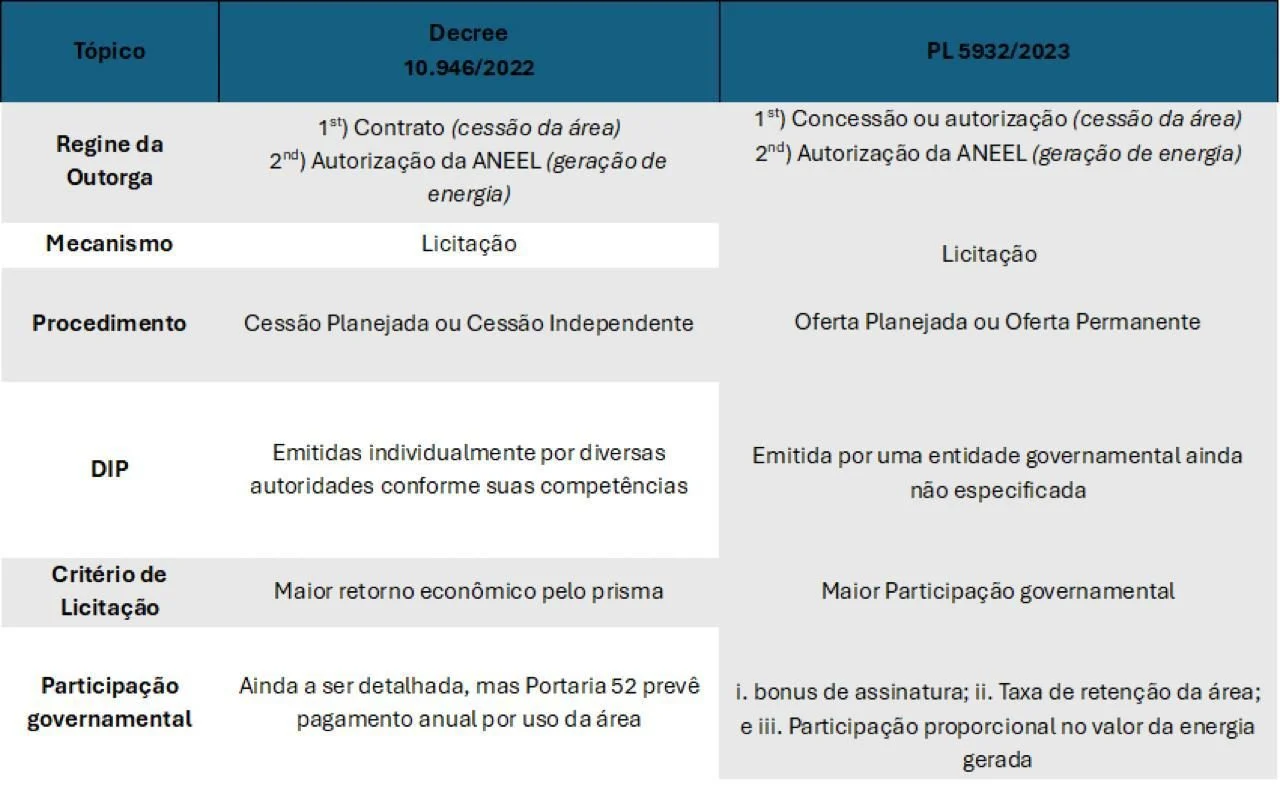
For reference purposes, we compare Decree 10,946/2022 in force and Bill 5,932/2023:
Both normative acts include provisions on the obligation to decommission.
Unlike the Decree, Bill 5,932/2023 establishes Authorizations and Concessions as concession regimes, while the Decree only establishes Use Attribution Contracts.
Both require the agent to obtain the Generation Authorization to generate energy, subsequently requested from Aneel.
Bill 5,932/2023 allows the installation of wind farms in inland waters, unlike the Decree, which focuses on maritime waters.
Both have provisions establishing rules for the technical, economic-financial qualification requirements of bidders and possible legal qualifications.
Both prohibit installation in areas that overlap with blocks allocated under oil and gas exploration and production frameworks.
Government Participations are defined in both, with the Decree aiming for the “Greatest Economic Return” and the Project specifying components.
Pending Topics
Regardless of how offshore wind energy regulation progresses, the questions still under discussion are:
Grant Regime: The current framework (Decree 10,946/2022) involves a dual concession regime: Cession of Use Agreement to grant the right to use maritime space and an Aneel Authorization for energy generation. Bill 5,932/2023 prescribes both Authorizations and Concessions for the use of the area. Both formats work in our opinion. The most important factor is that grants are granted through prior bidding, with objective criteria established, to guarantee legal certainty.
Bidding Criteria: Bidding criteria must be established in the legal framework, offering flexibility to adapt to advances in the sector. Bill 5,932/2023 provides for details of the bidding criteria in the bidding documents, allowing necessary adaptations according to the development of the industry. It is recommended that qualitative criteria be considered with price-based competitive processes.
Incentives: Tax benefits applicable to other industries can be replicated for the offshore wind energy sector. Advocacy among politicians and research by organizations are recommended for establishing tax benefits.
Coordinated Exploration: Preventing excessive exploitation of resources requires specific rules to avoid the wind wake interference phenomenon. The MME must play a proactive role in identifying the most concentrated areas, so that auctions in these areas are coordinated.
Government Participation: All frameworks propose specific government participation, to be detailed in the notice. Legally establishing maximum participation limits or fixed values is recommended. The regulatory framework must grant discretionary authority to adjust the applicable government participation for each bid, as proposed in Bill 5,932/2023. The final decision on the government shares applied must be reserved for the bidding documents.
Next steps
As for next steps, a solution to the criticism would be to review Bill 5,932/2023 to remove questions related to topics other than the offshore wind energy framework. A question that is asked repeatedly is whether we need to develop this industry. Electric energy is still a local commodity and difficult to export. However, there are several arguments in favor of the development of the sector:
Use of existing wind potential: Brazil has significant energy potential in the offshore wind sector, which, if not used, would be a “waste” of renewable energy.
Less Visual and Sound Impact: unlike other countries, Brazil does not yet face the “not in my backyard challenge”, related to onshore wind farms. However, this may change in the future.
Job Creation and Economic Stimulus: Generates local jobs and stimulates the economy in coastal areas.
Energy Security, by further diversifying the energy matrix.
Technological Innovation, for stimulating the development of new technologies and engineering practices.
Our understanding is that, when the lights go out, the market itself decides whether a certain sector deserves investment or not. However, in order for us to receive this response, we need to achieve a safe regulatory environment and a tax environment that encourages the development of the sector, rather than serving as a barrier to the monetization of said energy potential. However, today we have a heated market interested in investing, but prevented by a lack of regulation. This deserves to be resolved quickly.
This article exclusively expresses the position of the authors and not necessarily of the institution to which they work or are linked.
 Brazil Energy Insight
Leave a comment