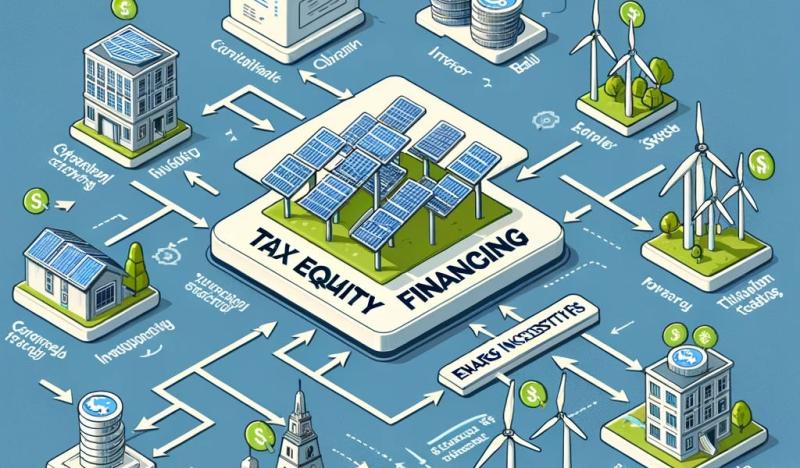
(GIS) Engie North America secured over $1 billion in tax equity financing from JPMorgan, Goldman Sachs, and BNP Paribas to finance the development of six renewable projects, focusing on diverse U.S. markets under the ERCOT, MISO, and SPP regions, with a combined capacity of 1.3 gigawatts. Engie’s involvement in the ERCOT market is important including a collaboration with Schneider Electric on a solar-plus-storage project in Texas.
Tax equity investments are federal incentives that serve as a key element in the financing structure of renewable energy projects in the U.S. These benefits enhance the financial returns of projects and play a critical role in the US renewable sector’s growth.
The broader landscape of renewable energy financing is witnessing a shift, especially with new financial tools and mechanisms introduced by the U.S. climate package. For example, the U.S. has witnessed a surge in solar PV asset funding following legislative changes, underscoring a broader global trend toward increasing capital allocation to renewable energy.
The underlying projects:
The financed portfolio includes projects within the Electric Reliability Council of Texas (ERCOT), Midcontinent Independent System Operator (MISO), and Southwest Power Pool (SPP) regions, totaling 1.3 gigawatts (GW) of clean energy.
Project Breakdown:
The bulk of the investment, 950 megawatts (MW), is allocated toward solar energy projects. The remaining 353 MW is dedicated to wind energy projects.
Engie has a notable presence in the ERCOT market, with recent virtual power purchase agreements (VPPAs) for solar projects like Bernard Creek and Chillingham, highlighting the company’s strategic expansion in Texas. It also has investments in this region the MISO and SPP Regions.
Engie’s agreements includesuch the Tax Credit Transfer Agreement (TCTA) with Schneider Electric for a Texas solar-plus-storage project.
Understanding Tax Equity Financing in Renewable Energy
Tax equity financing is a critical component in the funding structure of renewable energy projects in the United States. It’s a financial arrangement that leverages federal tax incentives to attract investment into renewable energy:
How Tax Equity Financing Works:
Tax Incentives: The U.S. government offers various tax incentives for renewable energy projects, including the Investment Tax Credit (ITC) and the Production Tax Credit (PTC). These incentives are designed to reduce the tax liability for entities involved in the development of renewable energy.
Investor Engagement: In tax equity financing, a tax equity investor provides capital for a renewable energy project in exchange for the right to use the project’s tax benefits. These benefits include the ability to claim tax credits and to depreciate the project assets, leading to significant tax deductions.
Project Development: The capital provided by the tax equity investor is typically used to fund a significant portion of the project’s construction and operational costs. This financing model allows renewable energy developers to leverage their projects’ tax benefits to attract investment, even if they themselves cannot utilize these benefits directly due to insufficient tax liability.
Financial Structure: The structure of a tax equity deal can be complex and is typically customized to the specifics of the individual project and the stakeholders involved. Common structures include partnership flips, sale-leasebacks, and inverted leases, each with its own method for allocating tax benefits and cash flows between the investor and the developer.
Risk and Return: Tax equity investors generally receive a lower risk-adjusted return compared to other types of equity investors, as their return is largely driven by the tax benefits they receive. The developer, on the other hand, benefits from the upfront capital investment, which reduces the need for debt financing and improves the project’s overall financial feasibility.
Tax equity financing has been instrumental in the growth of the renewable energy sector in the U.S., making up a significant portion of the capital stack for many projects. Its importance is underscored by the fact that it constitutes between 40 to 60 percent of investments in most renewable energy projects.
Tax equity financing is a critical mechanism within the renewable energy sector, enabling a range of companies to leverage federal tax incentives to attract investment for renewable energy projects. This financing structure is not exclusive to Engie; numerous other entities across various scales and sectors are also utilizing it to advance their clean energy initiatives.
 Brazil Energy Insight
Leave a comment