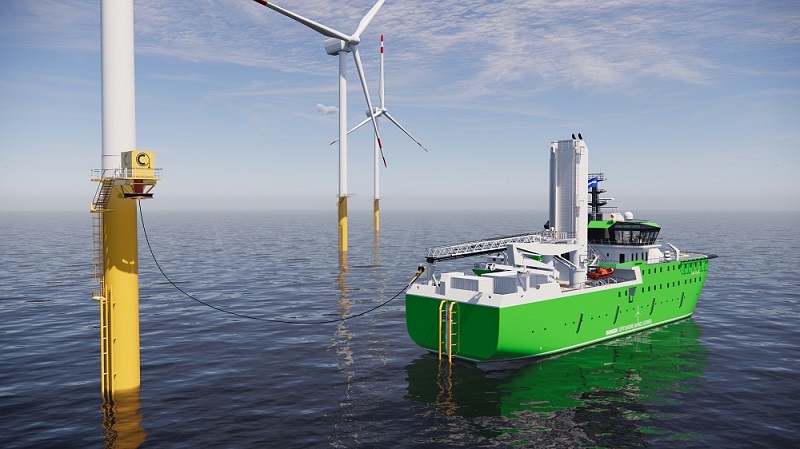
Damen Shipyards Group has officially launched its latest vessel, a fully electric Service
Operations Vessel (SOV), 70 metres x 17 metres. With its offshore charging capabilities, the vessel
paves the way for significantly reduced emissions in the maintenance of offshore wind farms.
Creating a total solution
Three years ago, Damen set out to assess the feasibility of an electric SOV to dramatically increase
sustainability of vessel operations at offshore wind farms. The shipbuilder quickly established that
technically it would be possible. However, two main questions were to be answered. Firstly, for this to be
possible, offshore charging capabilities would be required. Secondly, given that this model represents an
increase in CAPEX costs, it had to be established if there was a healthy business case.
To achieve offshore charging, Damen has partnered with UK-based MJR Power & Automation – a
company that has previously developed an offshore charging system for a crew transfer vessel. MJR took
up the challenge, developing a system that was fast, efficient and, above all, safe.
Safe, efficient and cost-conscious charging
The charging system uses the motion-compensated gangway to create a connection between the vessel
and a turbine or substation offshore, in much the same way a personnel transfer is undertaken. Damen
and MJR selected the charging method in order to maximise safety and efficiency. The gangway is
controlled from the wheelhouse, requiring no manual interaction with charging equipment. It has the added
benefit of utilising pre-existing offshore infrastructure, thereby adding considerable cost-efficiency.
Charging is carried out while the vessel is in a low power, so-called ‘green’ DP mode, requiring less energy
than the hotel load. A full charge typically requires energy produced in just a few hours by a single turbine.
The system is designed according to international recognised safety standards, including IEC/IEEE
80005-1. Additionally, it is about to obtain DNV AIP (Approval In Principle) and is designed in accordance
with forthcoming offshore charging standards under collaborative development by DNV UK and Norway.
MJR has developed a 4MW charger connector, sufficient for a 70-metre vessel. The company is also
working on a scaled up 8MW, version that will enable charging of larger vessels, up to 90 metres.
Paul Cairns MJR M.D. states, “The charging system is designed to be safe, convenient and reliable, with
rapid connection and disconnection of the charge umbilical. From the outset of this project, the priority
has been to ensure the safety of personnel and integrity of the vessel and offshore assets, under all
conditions. Charging from an offshore asset represents optimal practicality, providing a means to reduce
costs and emissions and optimise efficiency without placing personnel nor infrastructure in a potentially
hazardous situation.”
Return on investment
In order to answer the second question, of whether or not there exists a healthy business case for such
a vessel, Damen performed a business case analysis. This analysis took into account many different
parameters, including investment cost for chargers and batteries, replacement of batteries, energy costs,
price of CO2, large variations of operational profiles, and charge times. The input parameters have been
validated in close cooperation with wind farm developers and other stakeholders. Many different scenarios
have been analysed, but all had in common a healthy return on investment, ranging anywhere between
5 and 15 years, depending on the scenario.
Towards a more sustainable battery
The SOV 7017 E features a 15MWhr battery, sufficient to power the vessel during a full day of operations.
The battery is lithium iron phosphate (LFP) in place of the more conventional lithium nickel manganese
cobalt (NMC) battery type. This is aimed at maximising the vessel’s sustainable credentials. LFP batteries
offer the advantage of being less dependent on sensitive raw materials, particularly cobalt.
LFP also offers improved safety performance, being less susceptible to ignition and, in the event of
ignition, being easier to contain.
In the event that the vessel cannot access electricity for a short period, the SOV 7017 E features full
redundancy and is able to continue operations with conventional diesel propulsion.
Further increasing efficiency, the SOV 7017 E boasts Damen’s DPX-DRIVETM layout, featuring four
azimuth thrusters providing propulsion independently in any direction and offering considerably reduced
underwater noise levels.
The vessel has all the storage space, workshops, and deck space to undertake the broad scope of
transportation and work expected of it. Its 60 cabins provide comfortable accommodation for crew and up
to 40 technicians.
A call for collaboration
Mark Couwenberg, Damen Product Manager Service Operations Vessels, said, “The product launch of
the SOV 7017 E demonstrates that the technology is there to make offshore operations fully electric. The
reduction in OPEX implied by harvesting energy directly from the offshore wind farm implies a business
case for this model. We cannot do this alone, however. To make this a reality will require collaboration
throughout the chain, with shipbuilder, vessel operator and wind farm developer working together in
pursuit of mutual benefit. We’re looking forward to participating in such cooperations as we take this
concept forward. Together, we can make our offshore energy production more sustainable.”
 Brazil Energy Insight
Leave a comment