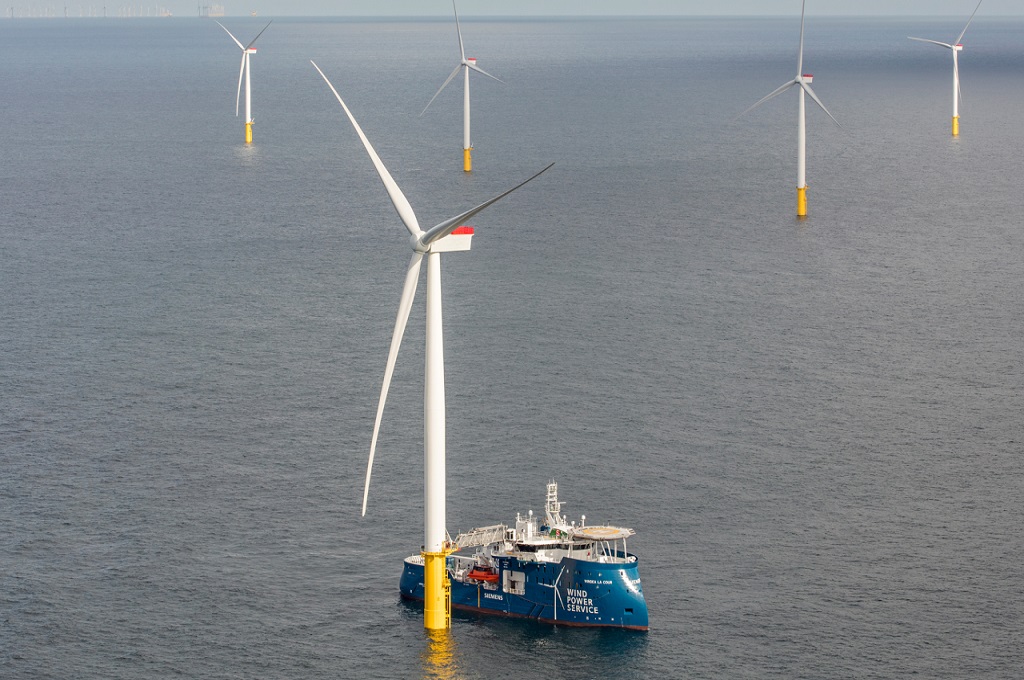
(Portos e Navios) The development of offshore wind projects in Brazilian jurisdictional waters has a way to go, but it has good indicators in different business areas. Sector agents consulted by Portos e Navios believe that the reduction of bureaucracy in the process and gains in scale will contribute to making projects viable, attracting new players and generating service and orders for the national industry. The assessment is that power generation and secondary activities such as desalination and green hydrogen are expected to increase support and construction demands. For the naval industry, the increase in offshore wind projects may represent requests for modification of existing vessels in order to complement the national fleet.
The Brazilian Association of Offshore Wind Farms (Abemar) considers that the country already has the necessary general rules in force, but there is still a lack of consensus for their application by some government bodies. The association is in favor of the project authorization system, as is the case in other sectors, such as railways. “Brazil has general laws and regulations that apply to offshore wind and allow the right to use physical spaces based on legislation, without bidding,” said Abemar President Marcello Storrer. He compared that, in the railway sector, the concession is always the result of authorization to the private sector.
Abemar’s understanding is that the Federal Constitution does not allow bidding if there is no equality of conditions, as everyone needs to start from the same point. “Abemar defends the application of general rules and making new specific rules help, and not hinder the private sector”, stated Storrer. In addition to firm energy contracts, Abemar points out that offshore wind projects will allow, in a secondary way, the desalination of water and green hydrogen as by-products that will help to enable the generation of this energy source at sea.
Storrer added that the country has a volume of projects that will allow the scale of production of items such as blades, generators and other large components in the future. He said that Brazil still does not have national suppliers for some items, such as steel pipes, but that entrepreneurs may be served by the Brazilian industry. Other items like concrete foundation would have plenty of supply. The generators are not yet made in Brazil.
The president of the Sectorial Chamber of Naval, Offshore and Onshore Equipment of the Brazilian Association of Machinery and Equipment Industry (CSENO/Abimaq), Bruno Galhardo, notes the need for new types of vessels operating in Brazil from the OWSVs (Offshore wind support vessels) family, which includes SOVs (Service operations vessels) and WTIVs (Wind turbine installation vessels). He foresees demand for future conversions of vessels in a first stage that, in the future, should demand the construction of new vessels to support offshore wind generation in Brazil.
“Offshore wind projects require support vessels that do not currently exist in Brazil. In this way, I see great potential for vessel conversions in the country”, highlighted Galhardo. He added that the energy transition is also transforming the very vessels that are migrating to projects with cleaner propulsion, such as hybrid, electric and nuclear.
Wärtsilä believes that the offshore wind segment still has some time to mature. The manufacturer has participated in discussions in groups and events with sectorial agents on the subject. The assessment is that this market is promising and will demand specific vessels. “In Brazil, we have a potential [for offshore] as great as for onshore (land), looking at the medium and long term”, projected the senior manager of market innovation at Wärtsilä, Lucas Corrêa.
Vessels for this new market have some similarities with offshore support boats that have some type of equipment that allows support for maintenance on wind towers. Wärtsilä sees this niche as a future opportunity for diversification for companies operating in the offshore support market and which can bring some kind of benefit to the chain, especially shipowners accustomed to operating complex vessels such as PSVs (Supply Transport), AHTS ( anchor handling) and PLSVs (line casting). Corrêa pointed out that this opportunity for shipowners to enter a new type of business still comes up against the lack of environmental regulations on the activity.
The Wärtsilä manager explained that there have been searches for projects to convert vessels that are ‘left over’ in the market to more complex vessels, which may pave the way for the case of development of the generation market for this source of energy at sea. “I believe it could be one of the markets for the future. It could be a good possibility for shipowners. The big difference is that the engagement must occur with players that are not currently part of the offshore support system”, said Corrêa.
Macnor Marine’s expectation is that the consolidation of this market in Brazil will be an important opportunity for potential business of vessel conversions and new constructions in the country. Macnor’s director, Pedro Guimarães, notes that this is a market that is already in full swing in Europe and is taking great strides in America. “The case of development of this industry in the USA will serve as a good thermometer for Brazil, since they are in the same direction, a few steps ahead compared to Case Brazil”, said Guimarães.
He added that wind generation in terrestrial parks in Brazil already has a developed and consistent industry for the manufacture and maintenance of the main components of the towers, since the source represents 10% of the national electricity matrix, and that the country occupies the 8th position in the world ranking installed capacity. Guimarães recalls that some items are still imported and that the difference lies in the logistics of installing the towers and systems at sea. He considers that preventive and corrective maintenance logistics are fundamental for the operation and efficiency of production.
Macnor is committed to offering solutions and support at all stages from the installation of the towers at sea, commissioning, operation and maintenance. Some of the Norwegian companies represented already have in their portfolio of solutions, projects dedicated to the offshore wind industry to serve this industry globally. Guimarães cites the company as the exclusive representative of Ulstein, which has been operating in the offshore wind market since 2006, as a designer of new constructions and conversions of existing ships. For personnel logistics dedicated to preventive and corrective maintenance, he highlighted that another company that Macnor represents (Maritime Partner), has in its portfolio of boats dedicated to the wind market, fast, called Walk-To-Work.
Guimarães sees that synergy with the existing naval industry will be fundamental to the success of this new industry. “With this synergy put in place, other constructive discussions will be convenient, such as, for example, joining the offshore wind market to the platform decommissioning plan, in which we could only uninstall the topside and reuse the existing structure for wind tower installations”.
 Brazil Energy Insight
Leave a comment