30 Sept, 2019
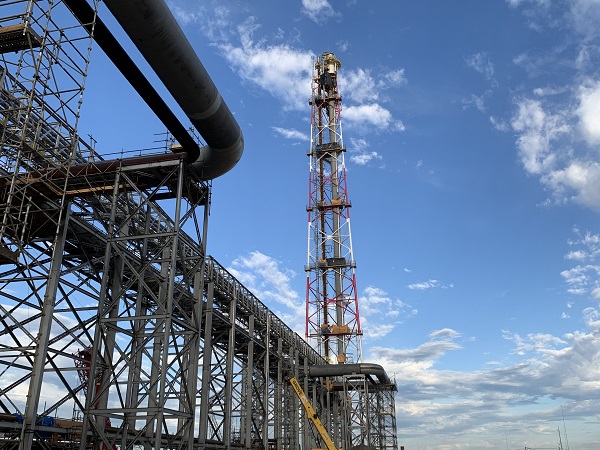
With 424 tons of steel and 156 meters high. If it were a building, it would be one of the tallest in the country. The new flare (torch) tower at the Natural Gas Processing Unit (NGPU), was installed in partnership with MIP Engenharia in the Integrated Route 3 Project, under construction in Itaboraí (RJ). The project will be the third route for the flow of natural gas production from the Santos Basin pre-salt fields and will have the capacity to process up to 21 million cubic meters of gas per day. The tower, the largest of its kind in Brazil, is the safety system for the burning of waste gas from these fields.
The installed flare is the primary safety system for commissioning – the pre-operation step when all systems and components are tested – and for NGPU commissioning. That is: only with this system ready to operate will it be possible to complete the other utilities and NGPN itself.
The 156m in height is justified by the need to disperse the gases and heat produced during burning in the event of an unexpected stop of any unit. The installed system has two headers (one burner): one for burning hydrocarbon gases, with a maximum capacity to relieve a flow rate of up to 1.4 thousand tons per hour, and another for acid gases, up to 240 tons per hour. In addition to the flare tower, the project has a 1,200m duct structure, Unit Substation and installation of vessels required for system operation.
The methodology used to assemble the modules that make up the tower was innovative. Petrobras used jigs for mounting these modules vertically, simulating the expected condition of installation in their final location. With this, it will be possible to ensure the maintenance of the positioning of the parts, avoiding difficulties and increasing the assembly safety during the movement and permanent coupling of these modules.
Route 3
In addition to NGPN, the Route 3 project includes the construction of a pipeline with a total length of 355km. Of this total, 307 km will be below the sea and have already been built, and another 48 km in the land section, which is under construction. The Route 3 Integrated Project will begin gas flow and processing in 2021. In addition to generating energy, Route 3 gas may be used in vehicles and industries. The project will contribute both to reduce the need for natural gas imports and to make it possible to increase the production of pre-salt oil, as it will increase the gas processing associated with the oil produced.
The project works currently employ around 5,000 workers, almost all from the surrounding municipalities. The hiring peak will be at the end of the second quarter of 2020, when the level of 7.5 thousand workers should be reached.
Source: Petrobras
 Brazil Energy Insight
Leave a comment