
Clashes between CEO, board threaten to hamper oil firm’s efforts to shore up its finances
By
PAUL KIERNAN
Nov. 5, 2015 7:57 p.m. ET
RIO DE JANEIRO—Growing friction between the chief executive of Brazilian state oil company Petróleo Brasileiro SA and its board is threatening to hamper the company’s efforts to shore up its finances, people familiar with the matter said.
An oil-workers strike launched Sunday has shut down up to 13% of Petrobras’s daily crude production, crimping the company’s already weak cash flow. In addition, continued upheaval in the boardroom is raising fresh concerns about a leadership vacuum as the company struggles to pare a mountain of debt.
On Tuesday, Clovis Torres, a board member standing in for Chairman Murilo Ferreira—who took an unexplained leave of absence in September—abruptly resigned for “personal reasons,” the company said.
Another director, union leader Deyvid Bacelar, who was elected to represent Petrobras employees on the company’s board, was arrested during a small protest as part of the strike on Monday and briefly detained. Mr. Bacelar has said the arrest was unjustified.
Tension in Petrobras’s boardroom reached a boiling point on Oct. 23, when Chief Executive Aldemir Bendine stormed out of a meeting and slammed the door after director Roberto Castello Branco questioned several of his proposals, two of the people familiar said.
Mr. Bendine and Petrobras declined to comment for this article.
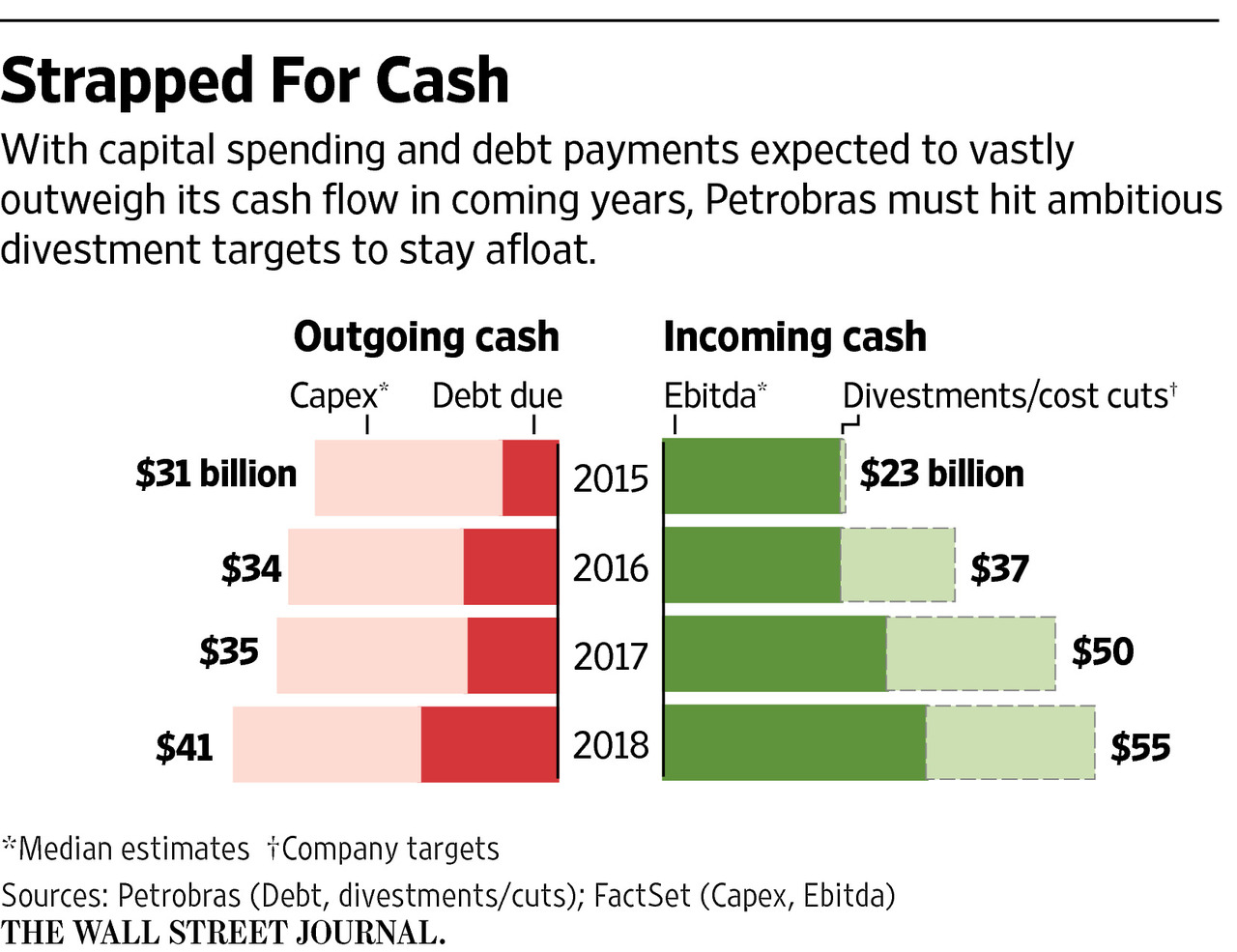
The turmoil is complicating Petrobras’s goal of selling $15.1 billion in assets through 2016 as it races to avoid insolvency. The company’s woes, which have forced it to slash billions of dollars in capital spending, are contributing to Brazil’s worst economic crisis in a quarter-century.
An oil-workers strike has shut down up to 13% of Petrobras’s daily crude production, crimping the company’s already weak cash flow. Pictured, a Petrobras oil rig near the coast of Rio de Janeiro. PHOTO: BLOOMBERG
“There’s really a leadership problem at the company,” says a senior official in the Brazilian oil industry, adding that the crisis has come precisely when Petrobras most needs strong management. “The situation is really worrisome.”
A steep depreciation in the Brazilian real has caused Petrobras’s $111 billion in foreign debt to explode in recent months and has driven up its cost of importing fuel due to a shortage of refining capacity. At the same time, low oil prices are hitting the company’s upstream margins and sapping investor appetite for the assets Petrobras has put on the block.
With some $12 billion in debt coming due next year, investors say the asset sales, along with heavy spending cuts, will be crucial for Petrobras to avoid the need for a government bailout, equity sale or debt restructuring.
But progress has been slow. Four months after disclosing its divestment plan, the only sale Petrobras’s board has approved was a 49% stake in its natural-gas distribution unit for 1.9 billion reais ($500 million). On Oct. 23, it decided to postpone a previously approved initial public offering of Petrobras’s fuel-distribution subsidiary, BR Distribuidora, citing “adverse conditions in the capital market.”
These recent moves by Petrobras and company filings suggest the board can’t agree on how to proceed with the asset sales. Making matters more complicated, the company is at the heart of a massive bid-rigging and bribery scandal that has upended Brazil’s economy and political system.
For the divestments it has formally announced, Petrobras has only proposed selling minority stakes.
But analysts say that strategy is likely to reduce sale prices, as investors remain wary of the Brazilian government’s interference in Petrobras’s affairs and of the company’s involvement in the corruption scandal that is still being investigated. To extract maximum value from its divestments, investors argue, Petrobras would have to hand over control of those holdings.
Mr. Bendine, the chief executive, has publicly ruled out selling some of Petrobras’s most promising assets, like its rich “pre-salt” oil fields off the Brazilian coast.
A significant faction of the company’s employees, represented by Mr. Bacelar, object to selling anything at all. The main union, the United Oil Workers’ Federation, contends that Petrobras should maintain its enormous rates of capital investment from recent years, despite assertions from Brazilian prosecutors that this fueled corruption.
Petrobras has said it was a victim of the graft and is cooperating with authorities.
More worrisome still is a perception by some in the company that Mr. Bendine himself isn’t up to the job. A career government banker appointed in February by PresidentDilma Rousseff to steer the company through the corruption scandal, he previously had no experience in the oil industry and few ties within Petrobras.
“There is no leadership,” said one of the people familiar with the matter. “The problem is Bendine because he is not a leader and he isn’t aware of the challenge that he faces.”
At the Oct. 23 meeting, the person said, Mr. Bendine brought up two spending proposals that the board had previously voted down: a sponsorship deal worth 75 million reais for Formula One auto-racing in São Paulo, and a publicity campaign seeking to improve Petrobras’s image in the wake of the corruption scandal, at a cost of 60 million reais.
Several directors felt that the proposals would send the wrong signal at a time when Petrobras is strapped for cash and shouldn’t have been raised repeatedly, according to the person.
“The tradition, the culture in Brazil, is that it’s the executives who run the company…the board is there to rubber-stamp what they do,” says John Forman, a longtime Brazilian oil consultant and former director of the National Petroleum Agency. “If they try to interfere they’re going to be resented.”
Petrobras’s stock has seesawed in recent sessions, with preferred shares in São Paulo closing 0.4% higher on Thursday at 8.11 Brazilian reais.
Write to Paul Kiernan at paul.kiernan@wsj.com
 Brazil Energy Insight
Leave a comment