
Petrobras Said Squeezed for Payment Five Years After Sale
12:00 AM BRT
May 19, 2015
The finance ministry is likely to seek reimbursement of as much as 20 billion reais ($6.6 billion) from the state-run oil producer as it recalculates the price of production rights granted five years ago as part of a record $70 billion share sale, said a person with direct knowledge of the matter.
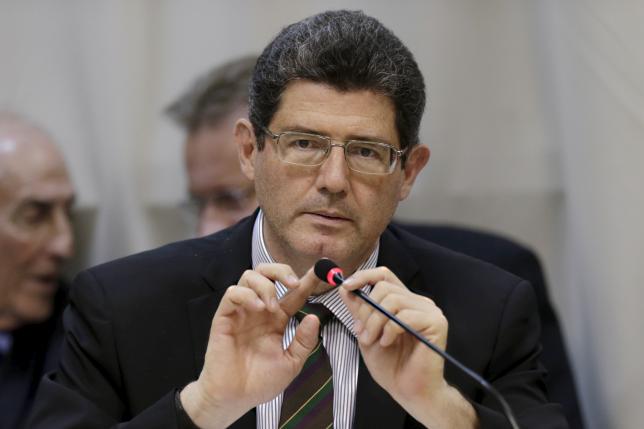
By demanding full payment under terms of the original transaction, Finance Minister Joaquim Levy would dash investor hopes for government relief as Petrobras sells assets and cuts spending in a bid to retain an investment-grade credit rating. Petrobras, whose shares have plunged about 50 percent since the share sale, scrapped dividends this year after posting a 21.6 billion-real net loss on project and graft charges.
The so-called transfer of rights payment is still being negotiated and will take into account operational costs, according to the person, who asked not to be identified because talks are private. The size of the payment probably will be finalized early next year, not in time to count toward the government’s 2015 primary surplus goal, the person said.
Five years ago, Petroleo Brasileiro SA, as it’s known formally, needed cash to develop a group of massive discoveries deep in the Atlantic Ocean. The government wanted to sell shares to outside investors without putting up any cash itself or losing control. So it traded five billion barrels of undeveloped reserves for $43 billion worth of Petrobras stock.
‘Abomination’ to Mobius
Emerging-markets guru Mark Mobius, chairman of Templeton Emerging Markets Group, denounced the share sale at the time as an “abomination” given how investors would have no oversight over a company that was no stranger to political manipulation.
Both sides agreed to revisit the value of the transaction after the fields were declared commercial. If oil prices fell, the government would compensate Petrobras. If prices rose, the opposite would happen. Most of the fields were declared commercial before last year’s 46 percent crude collapse, putting Petrobras at the wrong end of the deal.
“Investors are paying close attention to the amount that Petrobras will have to pay the government,” Cassia Inez Silva Pontes, an oil and gas analyst at Lopes Filho Consultoria de Investimentos, said by telephone from Sao Paulo. “The apprehension is exactly that — since it’s a new model, we don’t know how the value is being negotiated.”
Brazil’s Treasury is yet to define the value to be paid by Petrobras, the Finance Ministry press office said in an e-mailed response to questions. Regulator ANP is still reviewing the operational costs declared by Petrobras, it said. Petrobras decline to provide a comment.
‘Very Complex’
The topic is “very complex,” Solange Guedes, head of exploration and production, said Monday on an earnings call. The Rio de Janeiro-based company hasn’t made provisions for a transfer of rights payment, she said.
The negotiations highlight how minority investors get little consideration from a company that has resembled a development agency more than an international oil company. Petrobras lost tens of billions of dollars financing fuel imports when oil was trading above $85 a barrel. It is also required to buy locally-sourced goods and services, often at a premium, to help boost industrial activity in Latin America’s largest economy.
In 2010, Petrobras sold 2.4 billion common shares for 29.65 reais each and priced 1.87 billion preferred stock at 26.30 reais a piece in the world’s biggest share sale. The stock slumped 6.2 percent to 12.92 reais at 12:44 p.m in Sao Paulo Tuesday.
At the time, Petrobras paid $8.51 a barrel for 5 billion barrel production rights from the federal government. The price was set on a preliminary basis with the final amount to be recalculated in the second half of this year, based on a fixed return of 8.83 percent weighted average cost of capital, UBS AG said in a Nov. 18 research note. Payment could be done in cash, barrels or arguably in shares at uncertain valuation, UBS analysts Lilyanna Yang and Carlos Herrera wrote at the time.
 Brazil Energy Insight
Leave a comment