
http://www.ft.com/cms/s/0/32ab70fe-e2c1-11e4-bf4b-00144feab7de.html#ixzz3a6gH1A1D
May 14, 2015 11:08 am
Petrobras scandal looms large in Shell’s plan to buy BG Group
Joe Leahy in São Paulo, Jamie Smyth in Sydney, Christopher Adams in London/FT
As Royal Dutch Shell seeks to finalise its £55bn takeover of smaller UK-based rival BG Group, it will be closely watching the situation at Petrobras, Brazil’s state-controlled oil company that is engulfed in scandal.
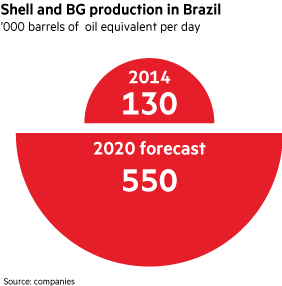
Brazil is the biggest prize in the deal for Shell — by combining with BG, the Anglo-Dutch group will become the largest foreign oil company in a country that has huge crude reserves.
But Brazil has the potential to become the location of the most troubled assets in BG’s portfolio because the UK company is partner to Petrobras in some of the vast pre-salt oilfields off the country’s east coast in the Santos Basin. There is a risk that Petrobras will struggle to fulfil its mandate as sole operator for all new pre-salt oilfields because of the corruption scandal, and that this leads to delays in developing the deepwater discoveries, including those involving BG, say analysts.
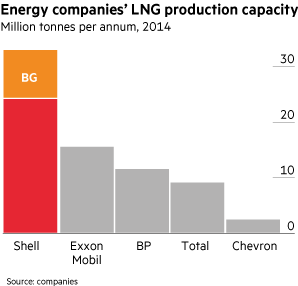
Brazil is not the only possible source of trouble in BG’s portfolio. The company’s Australian assets, which aim to supply China, Japan and other key Asian economies with liquefied natural gas, should cement Shell’s position as the world’s biggest private seller of LNG. But these Australian assets pushed BG to a pre-tax loss last year because of large impairment charges, and the company’s Egyptian operations have also had significant setbacks.
BG’s annual report is peppered with warnings about the regulatory risk arising from investigations into the Petrobras scandal, now considered Brazil’s biggest ever graft case, where former directors allegedly conspired with contractors and scores of politicians to siphon billions of dollars from the company.
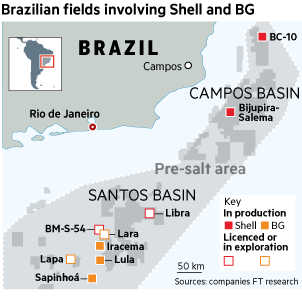
BG has stakes in five fields in the Santos Basin — three of which are producing oil — and the annual report says: “In Brazil, we are closely monitoring how the current corruption allegations affecting Petrobras may impact the cost and schedule of the Santos Basin [pre-salt] developments because of supply chain disruption and/or capital and liquidity constraints placed on Petrobras.”
As a virtual monopoly, most foreign oil companies in Brazil are required to work with Petrobras in most of the pre-salt area — the biggest offshore discoveries in decades when they were announced in 2007.
But many analysts say Petrobras, partly because of the magnitude of the scandal, does not have the capital or management bandwidth to be sole operator of all new pre-salt fields.
They add that the government may be forced to rethink the arrangements, and allow other oil companies to operate some of the fields, including foreign groups. “I think Shell is betting that probably the government will have to rethink its oil and gas policy,” says Adriano Pires, founder of the Brazilian Centre of Infrastructure.
The one piece of recent good news for Shell and BG has been that Petrobras last month belatedly released results for 2014.
It narrowly complied with a deadline that, if missed, could have put the company on a course to defaulting on its huge debt pile. Net debt stood at US$106.2bn at December 31.
However, the results also disclosed that Petrobras took a total one-off hit of US $16.8bn last year — of which US$2.5bn directly related to continuing corruption investigations into the company. These charges propelled Petrobras to a net loss of US$7.4bn in 2014, compared with a profit of US$11.1bn in 2013.
Ben van Beurden, Shell’s chief executive, said after a meeting with president Dilma Rousseff last month that the group had “a lot of confidence” in Brazil’s investment climate, and would look “very favourably” at any opportunities to deepen its positions in the country.
Shell operates several fields producing oil in the Campos Basin, part of the vast pre-salt area, but buying BG would give it much greater access to the Santos Basin.
Mr van Beurden, speaking a day after Petrobras issued its 2014 results, described it as “a very strong” company, adding: “I have 100 per cent confidence that Petrobras will come through this [corruption scandal].”
Aside from Brazil, Shell pinpointed BG’s liquefied natural gas assets in Australia as another important driver for the deal.
The assets include a US$20.4bn LNG plant called QCLNG on Curtis island, Queensland, which began shipping gas earlier this year after a lengthy building process and a US$5bn cost overrun.
High wages, a strong Australian dollar and technical difficulties in producing coal seam gas for QCLNG all contributed to the cost overrun.
Analysts are divided on the future prospects for QCLNG. Angus Rodger, analyst at Wood Mackenzie, says QCLNG successfully producing first gas last year would come as a massive relief to BG, but he warns the project is not out of the woods just yet.
“It was a big win to get the first LNG train [which reduces gas volume by liquefying it] operating, as the scale of the development is simply enormous, but there is still a question mark over how long it will take QCLNG to ramp up a second LNG train to full production.”
BG says it is confident it has “sufficient resources” for two LNG trains, and some analysts believe the worst is now over for QCLNG.
“Most of the challenges with construction have been overcome at this stage and with the second LNG train due to begin shortly, for Shell, the project has been de-risked to a large extent,” says Dale Koenders, analyst at Citi.
Additional reporting by Michael Kavanagh in London
| Egypt has been a thorn in BG’s side |
|
Egypt was supposed to be a key source of revenue growth for BG Group as it invested in Brazil and Australia, but the Nile Delta region has become a thorn in the side of the UK company, writes Michael Kavanagh in London. A combination of political turmoil and geological problems in Egypt, where BG operates several gasfields, has meant the country has fallen short of the company’s targets on production. In January last year BG was forced to declare force majeure and announced it would book a $3.1bn impairment charge against its Egyptian assets after the country’s authorities diverted gas previously destined for export to the domestic market. A halving of BG production in Egypt last year drove a 4 per cent fall in group output to 606,000 barrels of oil equivalent per day, in spite of a doubling of production from Brazil. The ejection of the Muslim Brotherhood from government in Egypt and its replacement with a regime headed by General Abdel Fattah al-Sisi has seen some recovery in the prospects of BG and other western energy companies in the country. However, Simon Lowth, BG’s chief financial officer, told analysts last week that Egypt was “moving to a domestic only business”. The company still cannot export gas. BG’s production in Egypt slipped again in the first quarter of this year, and the company said the regime still owed it $700m for gas put into the domestic market. Meanwhile, output from Brazil and Australia is rising, leading to a slight increase in BG’s production during the first three months of this year. |
Copyright The Financial Times Limited 2015.
 Brazil Energy Insight
Leave a comment